


Electricity Bill 101: What You’re Really Paying For
Many people quickly glance at their monthly energy bill, focusing only on the due balance and skipping over the breakdown of charges. However, understanding these details is key to finding opportunities for savings. Your gas or electricity bill goes beyond the power you use. It also includes transmission costs, distribution fees, and taxes that directly impact your total.
In the U.S., the average household consumes about 10,791 kilowatt-hours (kWh) of electricity annually, or about 899 kWh/month. However, your average household usage will vary depending on the type of home you live in and where it’s located. For example, Louisiana has the highest residential usage at 14,774 kWh/year, largely due to the demand for air conditioning during hot Southern summers. Alternatively, Hawaii has the lowest annual usage at 6,178 kWh/year due to its mild climate and more sustainable lifestyle.
By understanding how these factors contribute to your monthly bill, you can take control of your energy costs and uncover potential savings opportunities.
Breakdown of the Average Energy Bill
When it comes to energy, knowledge gives you the power manage, or even lower, your energy costs. Learning how to read an electric bill provides the skills you need to make more informed energy decisions. Whether you want to switch suppliers and shop the market or want to better understand your household’s energy usage, Price to Compare can help!
What does the electric bill include, exactly? Find out with our simplified breakdown of the top six components of your natural gas or electricity bills below.
Pro Tip:
If you haven’t chosen a supplier, your bill will list a Price to Compare, or Standard Choice Offer, determined by your utility. This rate is a great comparison tool when shopping for a better rate through our online marketplace!
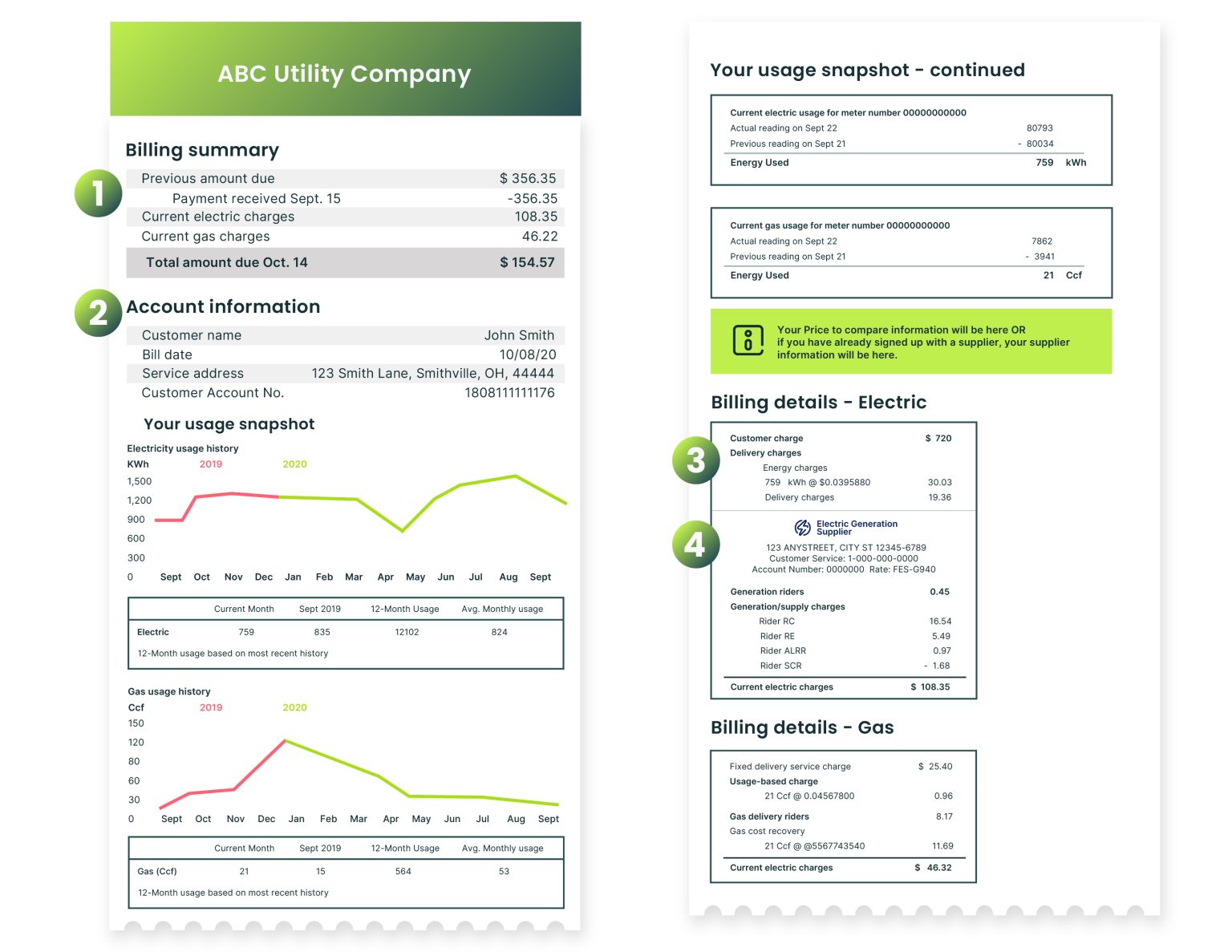
1. Billing Summary
Your billing summary provides a basic overview of your utility account, including your most recent payment activity and the current balance due. The payment due date will also be noted in bold.
2. Account Information
Typically, your utility account information will be listed towards the top of your bill, near the billing summary. This section will detail the account holder’s name, bill date, service address, and utility account number. Texas customers can also find their ESID number in this portion of the bill.
If you want to switch energy suppliers, keep your utility account number handy. It will be needed to finalize and activate a new plan.
3. Usage Snapshot Graph
Most utility bills include an energy usage chart that details your average consumption over time. Usage charts are incredibly helpful for identifying your household’s seasonal usage patterns. These insights can help you manage expensive seasonal energy costs and make impactful changes that lower your bills.
4. Energy Provider Information
If you’ve chosen a retail energy provider, their information will also be listed on your utility bill. It will likely be located just above, or even within, your energy supply charges. Your bill will include your chosen supplier’s name, address, contract information, and your supplier account number.
5. Delivery Charges
Delivery charges are determined by your local utility company and cover the cost of safely delivering electricity or natural gas to your home. These fees also help utility companies maintain energy infrastructure, including power lines, gas pipelines, meters, and transformers.
The name of these charges can vary by utility company but may include:
- Customer charges
- Distribution charges
- Transition charges
- Transmission charges
- Generation riders
6. Supply or Usage Charges
Your usage fees are determined by the amount of electricity or natural gas your household consumes during a billing period. Supply rates are also the residential energy rate you can compare from multiple suppliers in the energy market. With supply charges, the difference between gas and electric bills is simply the unit of measurement. Electricity supply is measured by kilowatt-hours while natural gas is measured by volume consumed.
If you’ve chosen a retail energy provider, the rates you’re charged are outlined within your residential energy contract. Otherwise, you’ll be charged your local utility company’s price to compare, or standard choice offer rate.
How to Find Your Price to Compare
In deregulated markets, if you haven’t chosen an energy supplier, you’ll automatically be put on your utility company’s price to compare. It may also be identified as the standard choice offer on your bill. When you compare energy rates from suppliers, measure them against the utility price to compare to make sure you’re getting the best deal.
Not sure where to find your utility’s standard choice offer rates? You can find them noted on your bill in several locations, including near the due date, important messages, account summary, or supply charges sections. Every state’s Public Utilities Commission will also have these fees noted on their website for consumer transparency.
Key Energy Bill Terms
To understand how to read electricity bills, you need to familiarize yourself with often-overlooked charges and units of measurement. Understanding these key details can help you negotiate better energy contracts and identify opportunities for cost savings.
Usage Terms for Electricity Bills
Kilowatt-hour (kWh)
A kilowatt-hour is a unit of energy measurement that calculates electricity consumption over time. It represents one kilowatt of power (1000 watts) used for one hour. Your total electricity bill is based on the number of kilowatt-hours you use each month, along with delivery fees and taxes.
Energy consumption varies considerably by device. For example, a 100-watt lightbulb must run for 10 hours to consume 1kWh while a 2000-watt appliance would only take half an hour.
Demand Charges
Demand charges are fees based on the highest amount of electricity used during a specific peak period. Utilities apply these charges during peak demand periods, when regional energy use is highest. For example, these fees would likely be applied during hot summer afternoons or cold winter mornings.
Seasonal demand charges fluctuate throughout the year, increasing as demand reaches its peak. While more common for businesses and industrial customers, some utilities will also charge residential customers. Contact your utility to see if these demand charges apply to your account.
Supply Charges
Supply charges, also known as generation charges, cover the cost of producing the electricity you use. In deregulated markets, these fees are determined by your chosen retail energy provider. Supply charges are based on your contracted rate per kilowatt-hour.
The type of energy plan can impact how your supply charge is determined, like fixed versus variable rates. When you compare plans with Price to Compare’s marketplace, you compare each provider’s supply rates. Choosing a plan with low, fixed rates can help lower your overall energy costs.
Delivery Charges
Delivery charges, also called transmission and distribution charges, cover the costs of delivering electricity to your home or business. These fees are determined by your local utility company. Delivery charges help utility companies maintain and upgrade energy infrastructure like powerlines, substations, and meters.
Taxes & Regulatory Fees
Taxes and regulatory fees are determined by local, state, or federal governments to fund various energy-related programs and services. These fees can include sales tax, environmental surcharges, or fund renewable energy projects. Taxes and regulatory fees will vary depending on where you live.
Usage Terms for Natural Gas Bills
British Thermal Units (Btu)
A British Thermal Unit (Btu) is a unit of measurement used to calculate the amount of heat energy required to raise the temperature of one pound of water by one degree Fahrenheit. In the context of natural gas, Btus are used to measure the energy content of the gas, helping determine its value and efficiency.
Therms
A therm is a unit of measurement for natural gas that is equivalent to 100,000 Btus. It is commonly used on natural gas bills to calculate the energy usage, with one therm providing enough energy to heat 100,000 cubic feet of air.
Ccf/Mcf
Ccf (hundred cubic feet) and Mcf (thousand cubic feet) are both units used to measure the volume of natural gas. One Ccf is equal to 100 cubic feet of gas, and one Mcf equals 1,000 cubic feet. These are the most common units of measurement used on natural gas bills, helping utility companies track and bill natural gas consumption.
Natural Gas Cost Conversion Chart
Many suppliers vary in how they price natural gas. Your bill could be determined by dollars per therm, Btus, or by cubic feet with Mcf or Ccf. This makes comparing natural gas rates a bit more complicated. To simplify the process, we’ve included a simplified conversion chart below.
To compare natural gas prices, you need the natural gas heat content per unit of measure. Most natural gas providers include this information in your energy bill or online account. However, you can contact your supplier directly to confirm this information if necessary.
Source: www.eia.gov/tools/faqs/faq.php?id=45&t=8
Energy Saving Tips for Lower Monthly Bills
Now that you have a greater understanding of your energy costs and consumption patterns, you can easily lower your monthly bill. Heating, cooling, and water heating make up about 43% of household energy consumption, making them key areas to target for energy savings. Practicing energy conservation and completing efficiency upgrades can help save between 5% and 30% in energy costs every year.
Below, we’ve gathered the best low-cost, high-impact energy saving tips to help keep your bills in check.
- Install a smart thermostat to optimize your heating and cooling costs.
- Upgrade to LED lighting which is up to 90% more efficient than incandescent bulbs.
- Seal gaps, cracks, and air leaks around windows and doors to reduce temperature loss and energy waste.
- Improve insulation in high-impact areas, like attics and exterior walls, to reduce energy waste through temperature loss.
- Prioritize off-peak hours to run energy-intensive appliances, like laundry machines or dishwashers.
- Invest in smart power strips and plugs to reduce standby energy waste.
- Reduce your water heater to 120℉ to reduce standby heat losses.
- Insulate your water heater tank to save 7-16% in energy costs/year.
- Lock in a low, fixed energy rate by using Price to Compare’s online marketplace.
What’s the Average Cost of Electricity?
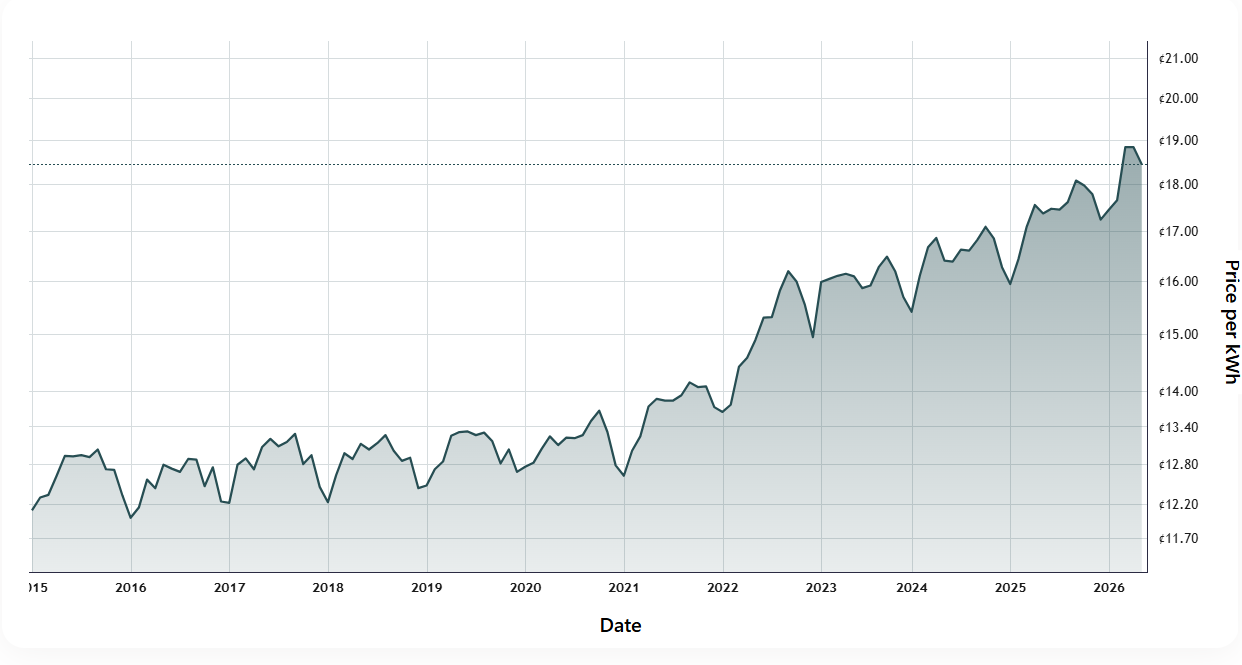
Electricity rates continue to rise. As of December 2024, the average residential electricity rate in the U.S. is 16.26¢/kWh. However, energy rates vary considerably depending on the region you live in.
For example, Hawaii has the highest rates in the country at 42.34¢/kWh while North Dakota has the lowest electricity rates at 10.21¢/kWh. Electricity rates vary depending on your state’s supply and demand dynamics and other market influences.
Compare Energy Rates with Price to Compare
Comparing energy prices and plans in your area has never been easier. Start saving on your energy bills today by exploring electricity and natural gas solutions.
Our Most Recent Blogs
Get the knowledge you need from experts you can trust. Browse our most recent blogs for practical advice, market updates, and helpful resources.